Van Gogh in Me is a live media performance fuse* conceived together with the Nederlands Kamerkoor, a professional choir based in the Netherlands. It consists in a real-time audiovisual experience where the works of two iconic artists, Vincent Van Gogh and Gustav Klimt, accompany the audience through an all-round, immersive journey through the fin de siècle of the 19th century.
Play
Pause
Mute
Mute
Mute
Unmute
The show retraces the history of the commonly called Belle Epoque, going from the 1870s to the outbreak of the first world war, through the melodies of musicians of the time - Satie, Debussy and Mahler - and the reimagined works of Vincent Van Gogh and Klimt. An emotionally-charged experience, the show is a succession of narrative climaxes where the history of those decades finds new interpretations through its cultural scene.
In addition, thanks to microphones and sensors placed on stage, the emotions, gestures and singing of the people taking part in the performance are detected and analysed in real-time, subsequently influencing the visual output of the show. A unique way to live the works of the artists, to stimulate diverse thinking and create new, unprecedented connections between elements: Van Gogh in Me is a new interpretation of the past that could not be more intertwined with our contemporaneity.
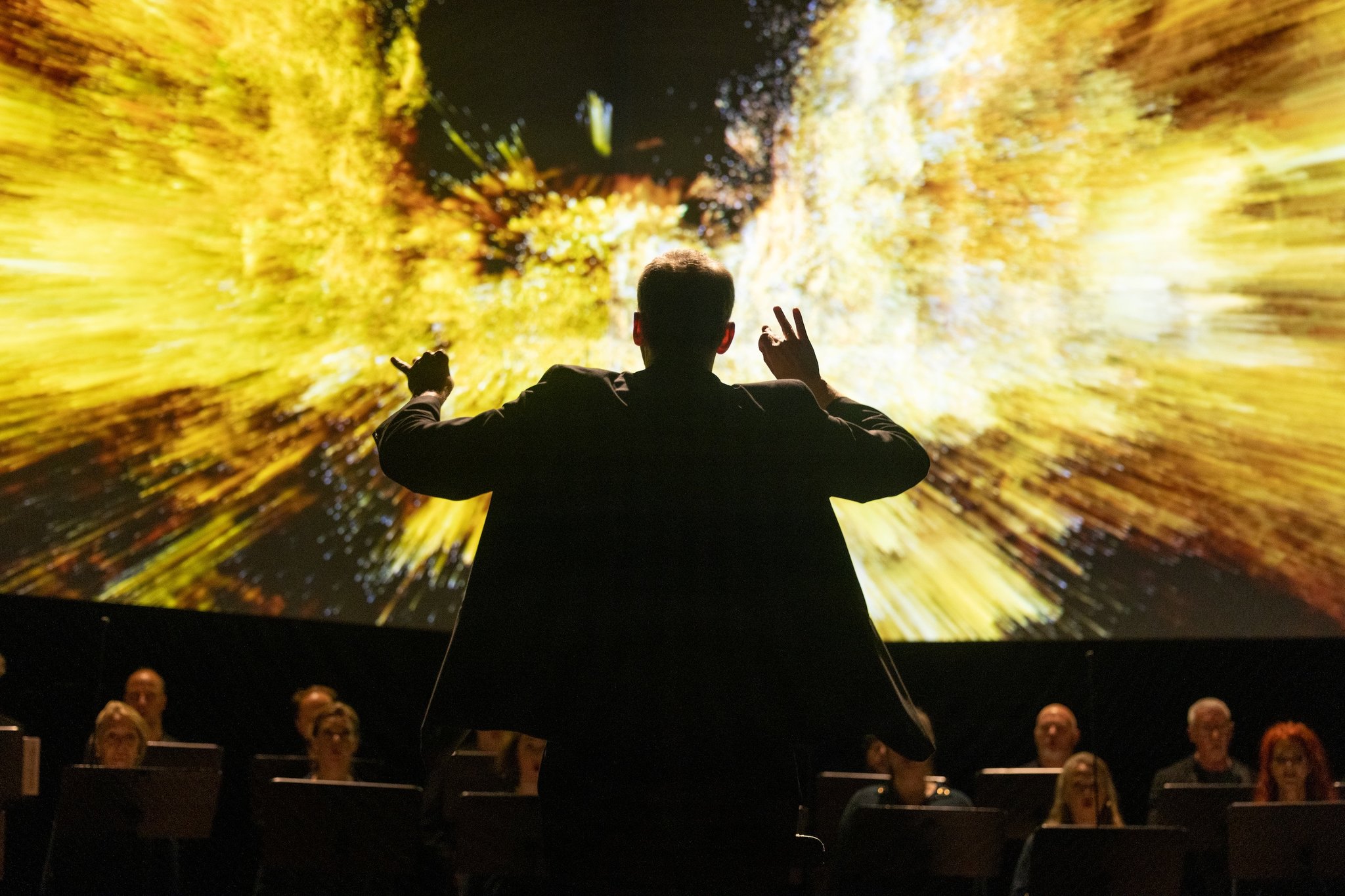
The main narrative of the show was developed by fuse* and the Nederlands Kamerkoor through a collaborative process that characterised the full production of the performance. The central idea was narrating Europe at the end of the 19th century (1880-1914), drawing bridges with the present through a stratification of events and meanings.
This interconnection of elements is reflected by the structure of the show and by the three languages employed: the choral music interpreted by the Chamber Choir, the visual level on which the artistic journey of the two artists takes place and, lastly, the technology, which processes real-time data. The final experience is a cross between performance, concert and participatory installation.
In the show, the boundaries between music and visuals blur: the paintings become audible, the sounds acquire materiality in an all-round experience that swallows the audience. The public’s role is not only about being spectators but becomes, together with the choir, an active participant in the creation of the work: it is their memory that activates the historical component, their emotions that influence the animations of the performance. All elements influence one another in an infinite loop, depicting a unique understanding of that time period.

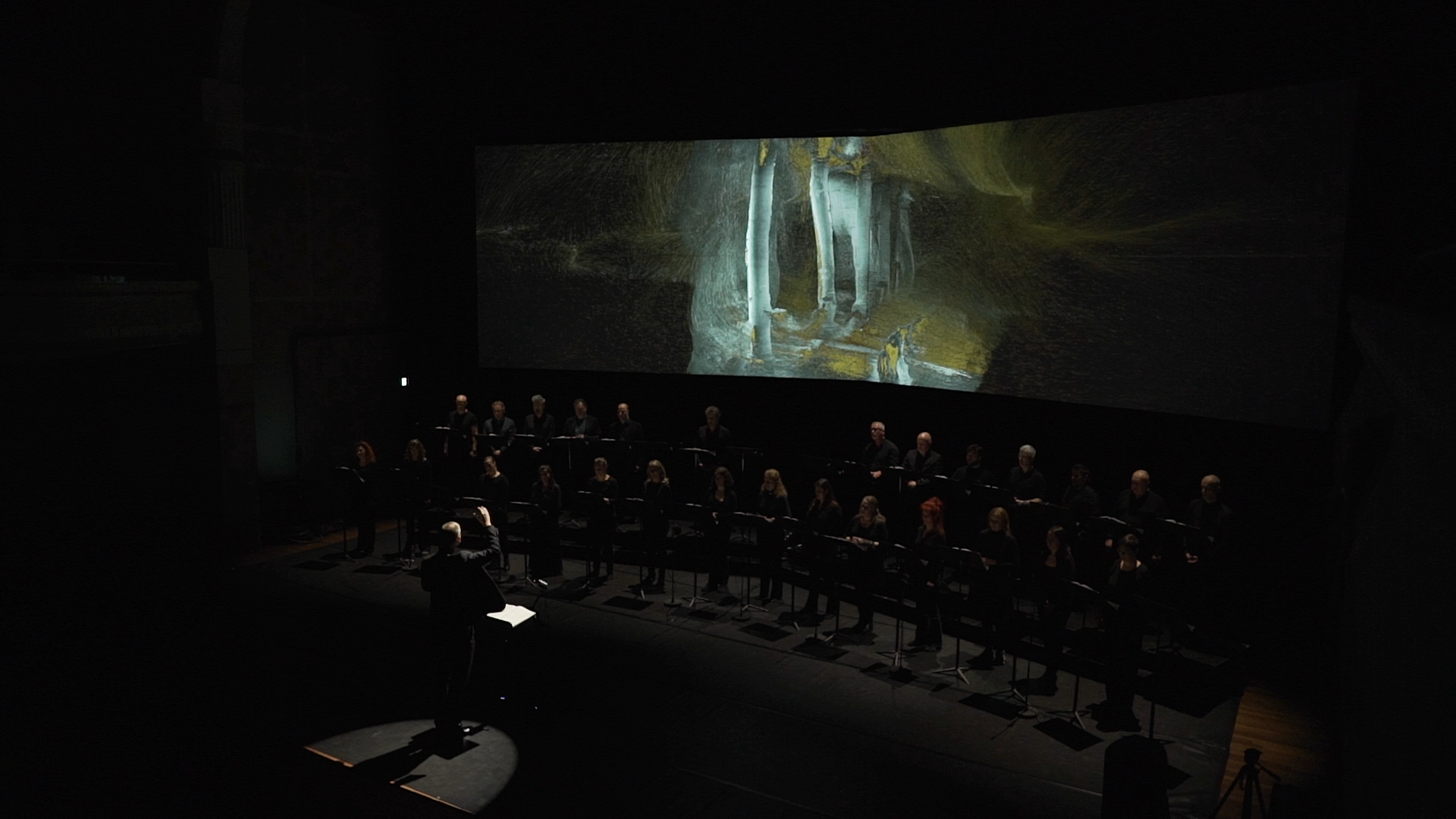
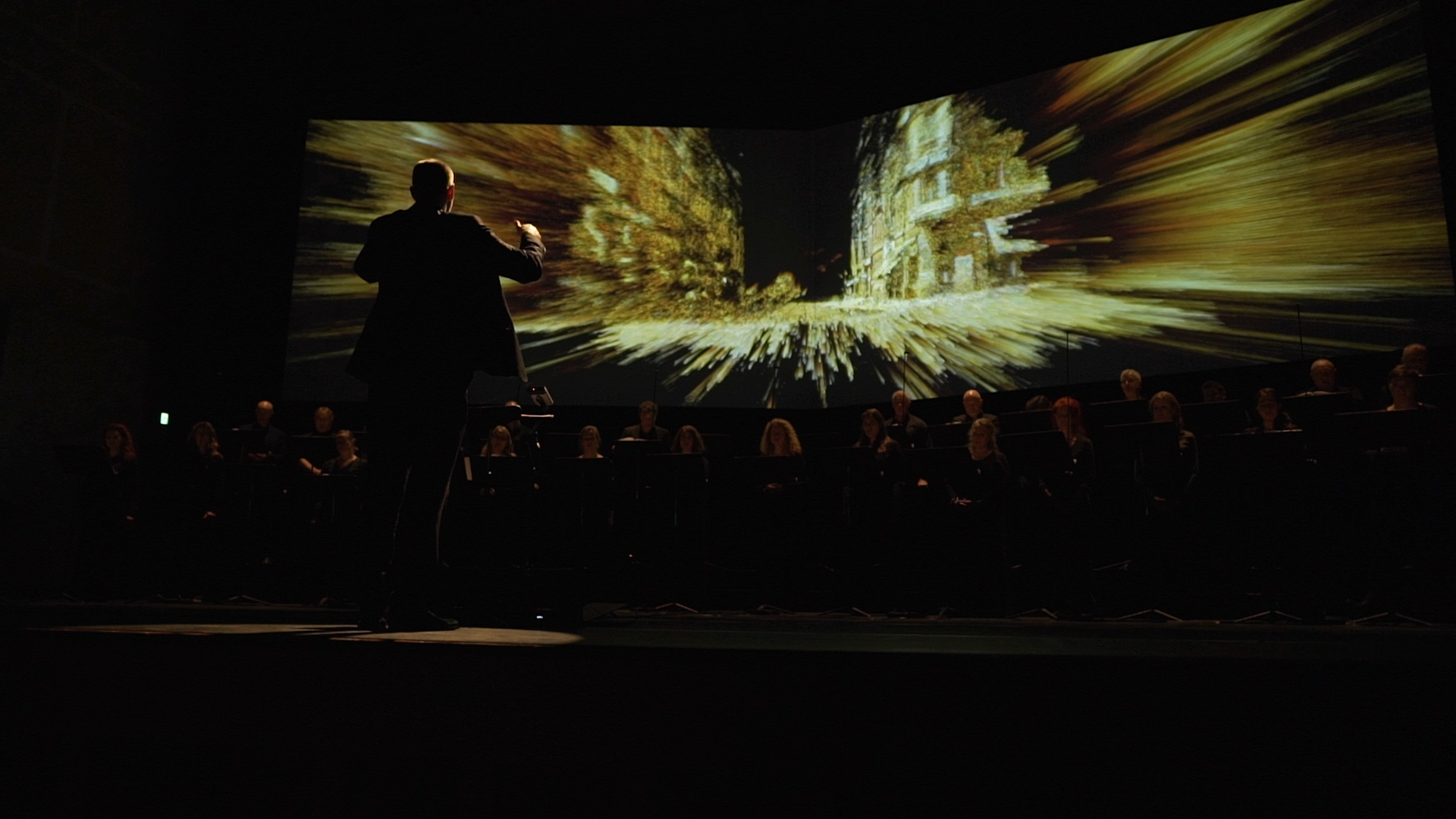
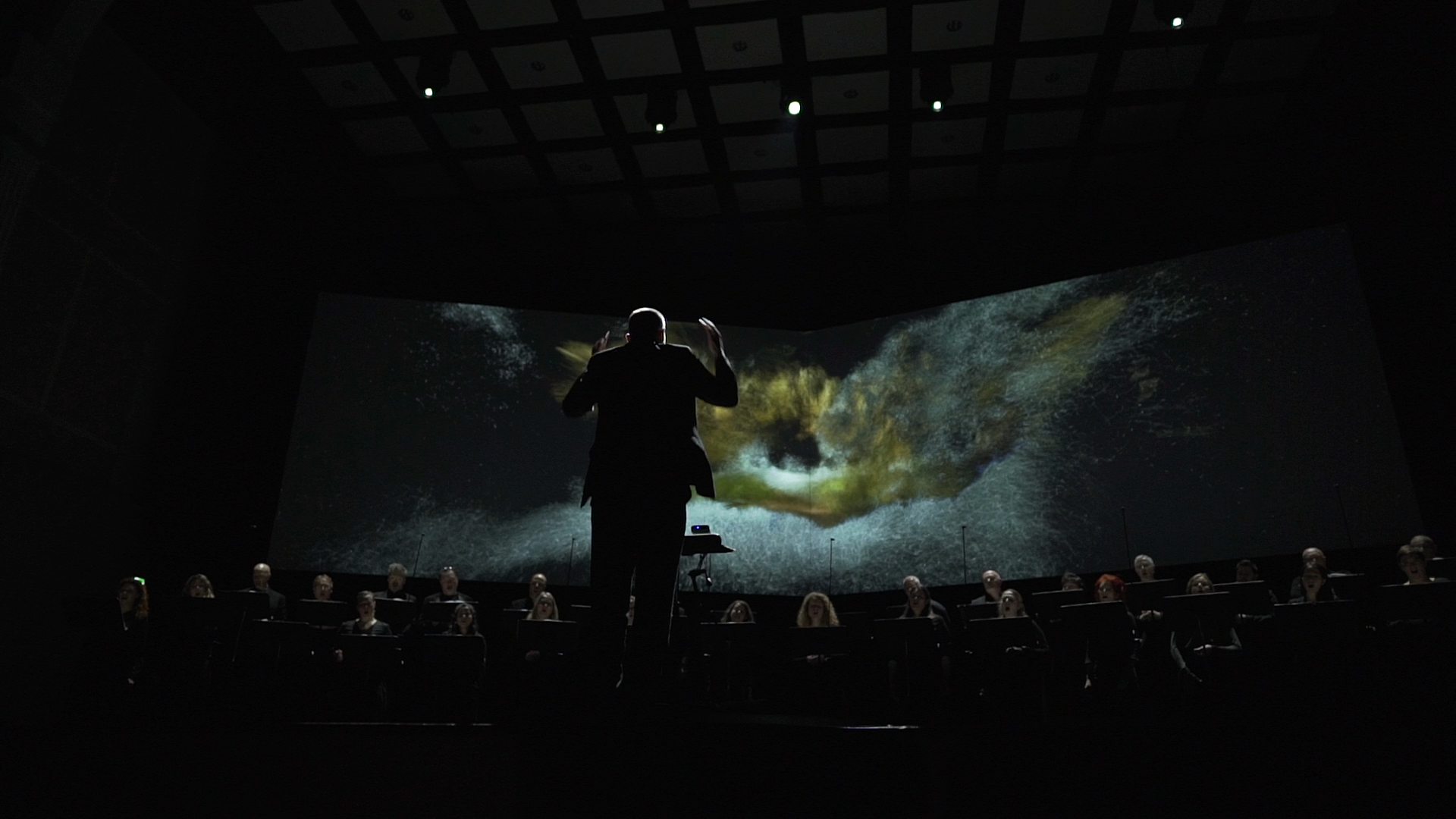
The storyline of Van Gogh in Me leads the audience through the fin-de-siècle through the life stories of Klimt and Van Gogh and the European historical context in which they lived. It is through their perspectives that the show tackles the historical events that interested the continent from the mid-19th century to the Great War, creating new parallelisms between the historical context and their personal lives.
The show develops around 15 musical pieces from composers of the time: Saint-Saens, Debussy, Rilke, Satie, Alma and Gustav Mahler, Strauss and Schönberg. Each composition enters in dialogue with the works of Van Gogh and Klimt and the historical background, adding a new layer of complexity to the narration.
These musical pieces symbolically reflect the lives of the two artists, covering their personal and artistic journeys. The first part delves into Van Gogh's life, transitioning from an intimate, personal perspective to a broader, collective, and eventually universal view: rural walks, portraits of peasants, inner turmoil, loneliness, and despair. The central section sublimates this torment through the expressive power of Van Gogh’s work and its impact on Klimt's art. The final part traces the evolution of Klimt’s style, depicting his retreat into beauty as World War I approached, culminating in one of his most striking works: the Beethoven Frieze. Similarly, the music mirrors the narrative, shifting between intimate and serene passages and darker, more unsettling tones.
At the same time, the audience witnesses the unfolding of events through historical films and photo material. Images of the bustling city and idyllic countryside leave space to the devastation caused by an impending war with marching armies and bleak trenches, to which follows a rebirth, the final return of peace, of new life, over the ruins of destruction.
In order to encourage the audience’s immersion in the narration and visuals, two LED screens are arranged in a V-shape behind the stage, hosting the 32 singers and conductor of the Nederlands Kamerkoor. The paintings of Van Gogh and Klimt, alternated with historical materials, evolve in continuous, slow-moving animations according to real-time data collected from the theatre hall.
These data impact the visual interpretation of the paintings. Central in the flow of data is the choral performance which, together with the musical elements, shapes the visual components of the show. The voices of the 32 choristers of the Nederlands Kamerkoor are detected through 8 panoramic microphones that return the overall musical image. Four soloists also wear a personal microphone, which allows a more in-depth sound analysis of the individual voice, and a GSR (Galvanic Skin Response) Shimmer sensor for real-time detection of their emotional state (Emotional Arousal).
At the same time, an infrared camera detects and collects the emotions of the audience through Face-Detection, successively extracting Emotion Analysis data from the spectators' faces.
Lastly, the conductor represents the physical and emotional link between the audience and the choir: the gestures and emotions derived from the expressions on his face are, in turn, analysed and added to the process.
All the parties that create and participate in the performance thus collaborate in the co-creation of the final work, which becomes an original, unique piece of art. In doing so, all the participating groups can perceive their own role and function in the creation of the performance, which places the audience in a completely different position: Van Gogh in Me allows for a participative action and gives new agency to the attendees by positioning them onto a level of importance closer to all the other parties that constitute the show.
Thanks to the collaboration with Van Gogh Museum of Amsterdam and Austrian Gallery Belvedere it was possible to work on high resolution images of the paintings. This allowed to train neural networks (through Generative Adversarial Network) on single paintings or on the basis of stylistic themes recurring in several works. These elaborations have become real explorations of the style and trait of the two artists, revealing a definition and a wealth of detail otherwise not perceptible to the human eye.
During the development of the visuals, we also tried to blend complex behaviours initially inspired by the organic world with the amount of data we were able to decode from the high-resolution paintings. The rules used to influence the agents take into account local features and the way in which the two artists distributed the pigments on the canvas.
This is where the set of data collected in real time during the performance comes into play: it is employed to influence and give a continuous variation to the visual behaviours and animations. The visuals evolve like a living organism in a continuous dialogue that goes back and forth between the audience and the choir, embodying the feelings and emotions of each specific performance.
At the same time, the lives of Van Gogh and Klimt are immersed in the atmosphere of the 19th century, recreated through photogrammetric reconstructions of the city of Vienna from historical films and photographic material of the time. The spatial, three dimensional component has been restored to the scenes through Depth Estimation techniques based on Deep Learning. The landscapes are also intertwined with the works and gaze of the two artists thanks to the application of the shades used in their paintings and to Style Transfer techniques on three-dimensional point clouds reconstructing the city of Vienna.
The music underpins and accompanies the whole narration of the show. The selected pieces focus on Paris in the late 19th century and on Vienna in the early 20th century. They are divided into 7 chapters that follow the dramaturgical line of the story: from a poignant choral setting of Mahler's Fifth Symphony Adagietto, to Richard Strauss' breathtaking "Traumlicht", to the defeatist "Ich bin der Welt should be Ich bin der Welt abhanden gekommen". The performance ends with Arnold Schönberg's Friede auf Erden from 1907, a direct reference to its visual counterpart, Klimt's Beethoven Frieze. The choice of focusing on an exclusively fin-de-siècle repertoire allows the music to function as a bridge between the past and the present, also reflecting the mood and emotions of its visual counterpart.