CUBO is a multimedia artistic space conceived and created on the occasion of Unipol’s 50th anniversary. It was established to narrate the Group’s collective memory, honoring the Group’s origins, growth, and development. In addition, its vision extends far beyond the walls of the company, positioning itself as a cultural hub for the local community and visitors alike. The museum is dedicated to those who have contributed to the history of Unipol through their work: employees, agents, and all stakeholders connected to the company, thus acknowledging the integral role of people in the Group’s history. The architectural project of the museum was designed and realized by fuse*, bringing this vision to life with a thoughtful and innovative approach.
The architectural design and technological infrastructure of CUBO was conceived and realized by fuse*, translating this vision into an immersive and interactive environment. Through a careful balance of physical space, digital media, and dynamic storytelling, the project reimagines the museum experience, fostering engagement and dialogue between visitors, the surrounding city, and the themes explored in the museum.
CUBO is also a gathering space that serves the neighbourhood, the city, and the wider region. It is designed to be freely accessible to all citizens of Bologna, tourists, and international visitors. The space’s peripheral location—while central to the company’s headquarters—reflects the intention to encourage the discovery of new urban areas, animate underutilized spaces, and promote an understanding of an ever-evolving society shaped by migration, integration and cultural exchange.
Beyond its role as a museum, CUBO is a multifunctional cultural space: for art, history, cinema, safety education, and identity exploration. It offers a space to reflect on contemporary issues and makes the memory of places, people, and society relevant to current conversations. The project's ambition is to fill its halls day after day, not only to share Unipol’s history but also to provide the public with engaging, dynamic cultural experiences.
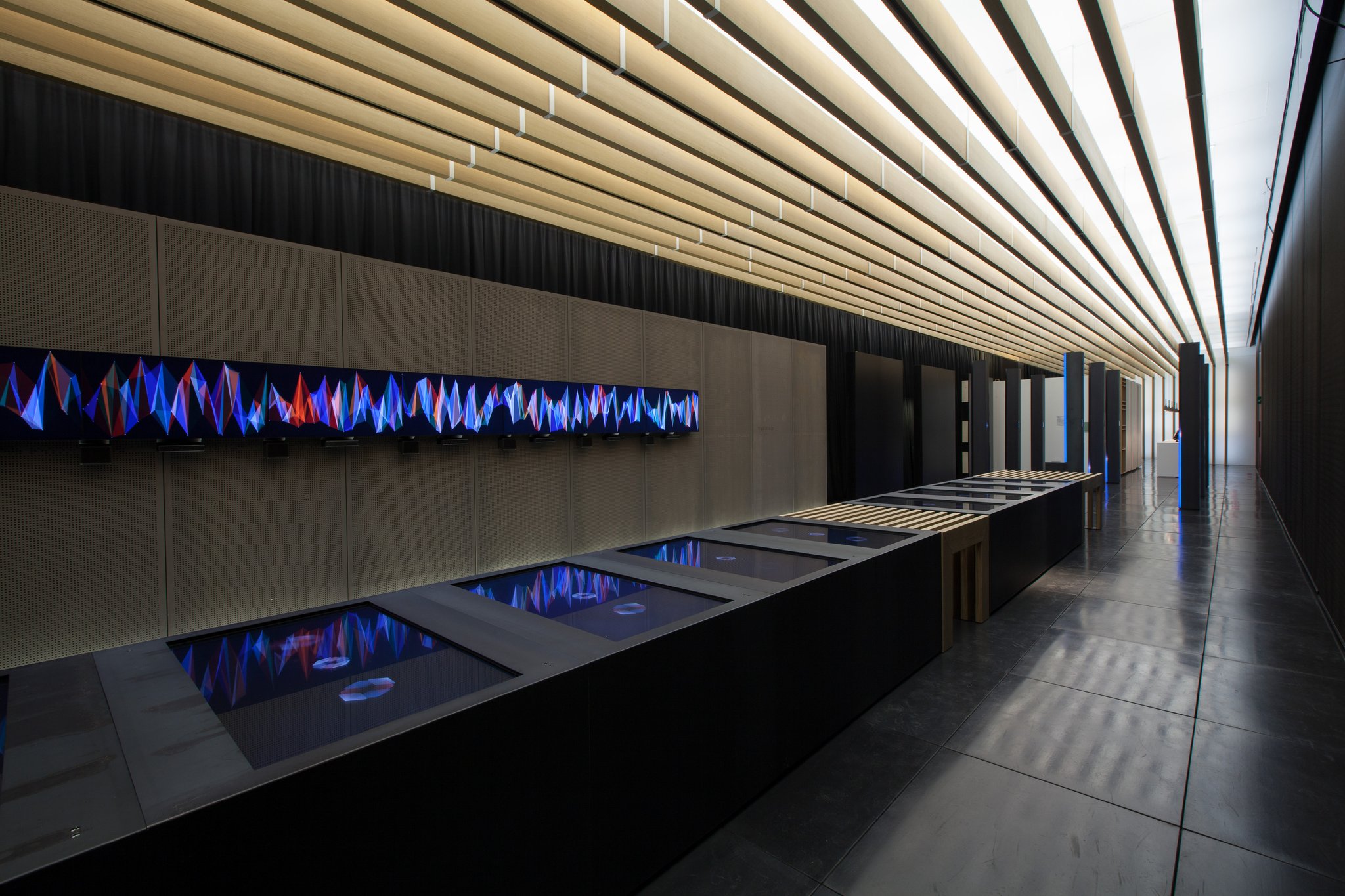
Technology and new media are increasingly integral to people’s lives, reshaping communication methods and transforming the environments where we live, work, and spend our free time. In architecture, digital innovations are opening new fields of exploration, offering alternative ways of conceiving, designing, and creating. Spaces themselves can be understood as media capable of telling stories and translating complex concepts into simple, intuitive languages.
The study of volumes, shapes, and materials seamlessly merges with the design of software, interactions, and technologies, resulting in an architecture that harmoniously integrates digital elements, physical space, and materials. The media-architectural design of CUBO was conceived with the goal of creating an environment that constantly interacts with its visitors, as well as with the city and global landscape.
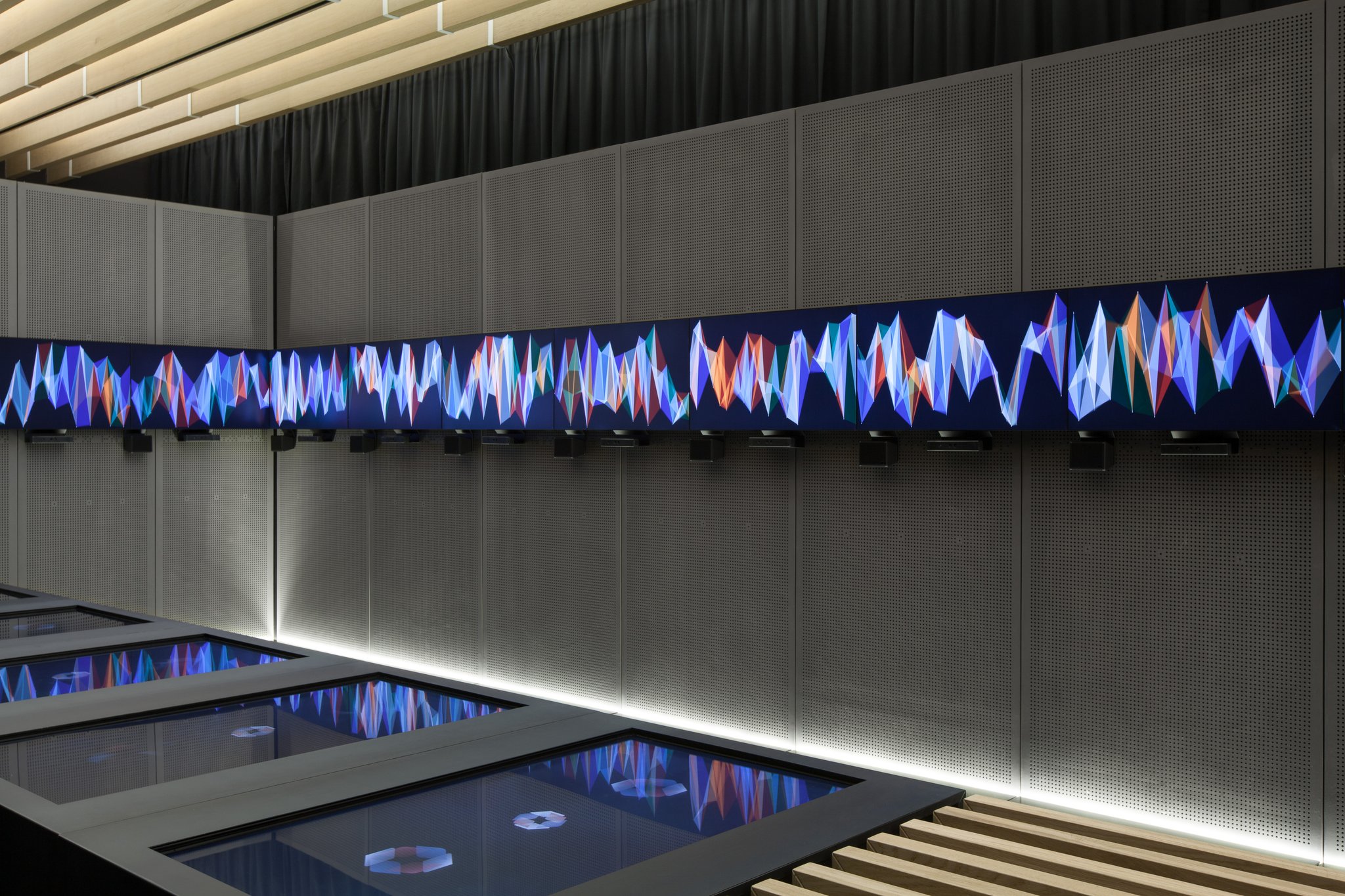
The design of CUBO’s spaces was primarily inspired by the presence of natural light. Preserving its uniform distribution, ensured by large perimeter glass surfaces, was a key factor in the development of the lighting systems. The linear arrangement of these systems complements the functions and layout defined in the architectural plan.
Lighting fixtures run along vertical lines, covering boundary walls, and horizontal lines, forming the false ceiling. This arrangement creates a grand, luminous portal that envelops the space in a diffused, adjustable light—both in temperature, quality, and intensity.
Every lighting element is managed by a home automation system integrated into the building's IT infrastructure. A sensor placed on the roof dynamically adjusts artificial light, ensuring a seamless transition from daylight to a soft and ambient nighttime effect.
To achieve these results, a specially designed system of wooden beams with an aluminum core was developed. These beams conceal the lighting elements while also housing additional visible fixtures on the underside, which highlight key areas for activities and create contrasts and focal points on the artworks displayed in the Spazio Cultura.
The emphasis on lighting created the necessary conditions to shape the spaces below, following the intended design vision.
One of the greatest challenges was to translate complex subjects and convey extensive information using media that are simple yet engaging and stimulating. To achieve this, the visit to CUBO has been conceived as a multisensory experience, where content is accessed through touch, movement, sight, and hearing. The technological platform is designed to be continuously updated, both in terms of content and interaction systems, ensuring that CUBO remains a dynamic and ever-evolving space.
This principle makes CUBO a living space, constantly growing and adapting.
CUBO was inaugurated on March 26, 2013, to celebrate Unipol’s 50th anniversary.
Our collaboration with Unipol continues through ever-evolving projects that integrate and modernize the museum’s entire technological apparatus. One of these projects is the CUBO app (2017), which allows visitors to explore the current exhibition at CUBO’s Spazio Arte independently, tailoring the depth of information to their curiosity and level of engagement. To enhance visitor interaction and deepen their involvement, we created Bloom —an experiential bridge between the exhibited artworks and the observer’s perception of them.
Bloom is generated by an algorithm that interpolates the analyzed artwork’s image with the user’s emotional preferences, shaping its form and color based on associated emotions while processing specific data from the original piece. Beyond individual visualizations, the data generated through user interactions contribute to a second display—an evolving collective artwork that reflects the shared perception of the artistic subject.
The algorithm behind Bloom is inspired by natural principles: stigmergy and attractors are used to guide a multitude of agents. Their trails, drawn as thousands of lines via OpenGL ES, create the Bloom visualization.
Mira (2023) is another custom installation for the Videowalls of the Spazio Live at CUBO. It aims to showcase the distribution and diversity of cultural sites in Italy and their relationship with the physical territory of the country.
The locations, surveyed biennially by ISTAT (the Italian National Institute of Statistics), are part of a mapping of Italian cultural institutions, both public and private. Using data from this database, we developed a system of maps where the presence and concentration of cultural sites reveal the most significant centers and their networks. The research and visualization can also be customised to distinguish between thematic categories, in order to highlight specific aspects through a tailored perspective.
By exploring the maps, users can observe the heterogeneity of the cultural landscape, as well as the strengths and gaps within different regions.
The Mira installation becomes interactive when the UltraLeap station is active. Positioned in front of the central screen on its designated pedestal, this sensor detects hand position and movement, enabling users to contactlessly navigate the map in four directions and point to specific areas to discover their cultural sites.
Commissioned by: Unipol S.P.A.
Communication and Contents: Togo Visual Action
Building Construction: Visual Exhibition
Architectural 3D Render: Alex Lomarco
Photo Shooting: Mattia Santini
LED Display and Lighting: efour
Internal Lighting System: Zumtobel
Audio System: d&b audiotechnik
Media System Forniture: Qualitech, Pqlabs, Samsung, HP, Nec, Microsoft.