“If we were to view the advancement of civilization from a linear temporal perspective, in one direction you would see 5,000 years of civilization; in the other, a future of rapid and iterative science and technology. Here we stand in ‘this moment’: a moment where we gather from our ancestors and move toward a new creation, a moment where we traverse the extended ‘past’ and proceed boundlessly into the future.” - Zhang Yimou
In September 2019, the National Center for the Performing Arts (NCPA) in Beijing hosted the third edition of 2047 Apologue, a visionary performance series conceived by Chinese director Zhang Yimou. Held annually, each edition of 2047 Apologue brings together a diverse group of international creatives and artists to explore the intersection of local ancient traditions and cutting-edge technologies through a series of original performances.
For the 2019 edition, fuse* was invited to create and direct a live media performance that would integrate Hua’er music, contemporary dance, a holographic projection system and two robotic arms, in collaboration with the robotic animation studio AndyRobot. Our work was one of seven acts, each uniquely developed by an international team in partnership with performers from Chinese folk culture.
Play
Pause
Mute
Mute
Mute
Unmute
千丈的黄河万年淌 The ten thousand feet long Yellow River runs for thousands of years
千里的风沙万里黄 A thousand miles of sand turns ten thousand miles of land yellow
千年的日月轮流转 Days and nights rotate for thousands of years
千年的城墙万里长 Thousands mile Great Wall has been standing there for thousands of years
The soundtrack of the performance is a Hua'er song, a folk music genre from the northwestern provinces of China, recognized as Intangible Cultural Heritage by UNESCO in 2009. The dynamics of the music and the themes explored in the piece shaped the conception of the performance. The lyrics encapsulate symbolic elements of Chinese culture: the light of the moon, the relentless passage of time, and the flowing rivers. In various ancient cultures, including Chinese, the image of a river has often been likened to the celestial sphere, with the Milky Way considered the heavenly counterpart of the major earthly rivers. This parallel between earthly currents and astral movements became a key interpretive element of the project.

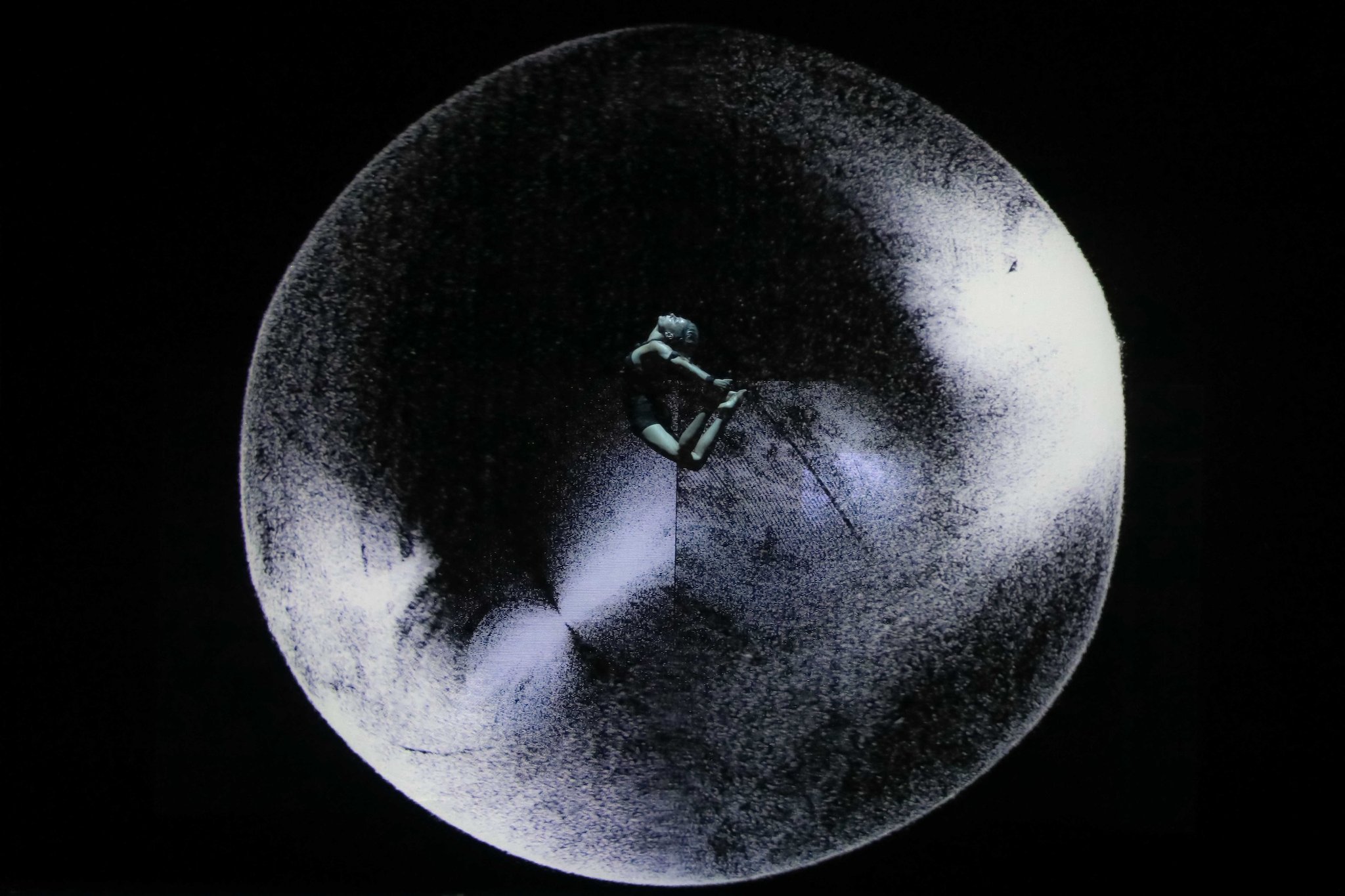
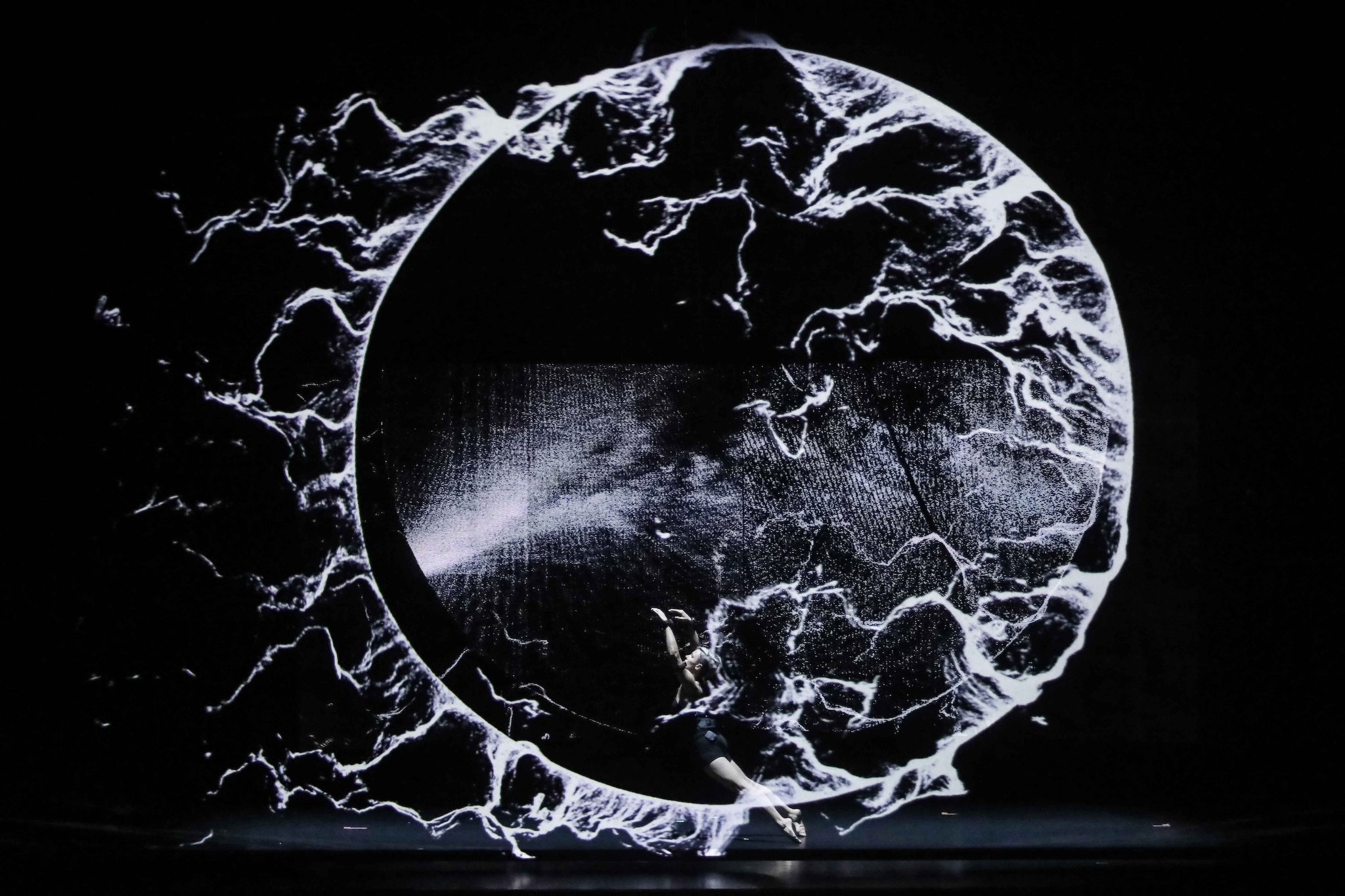
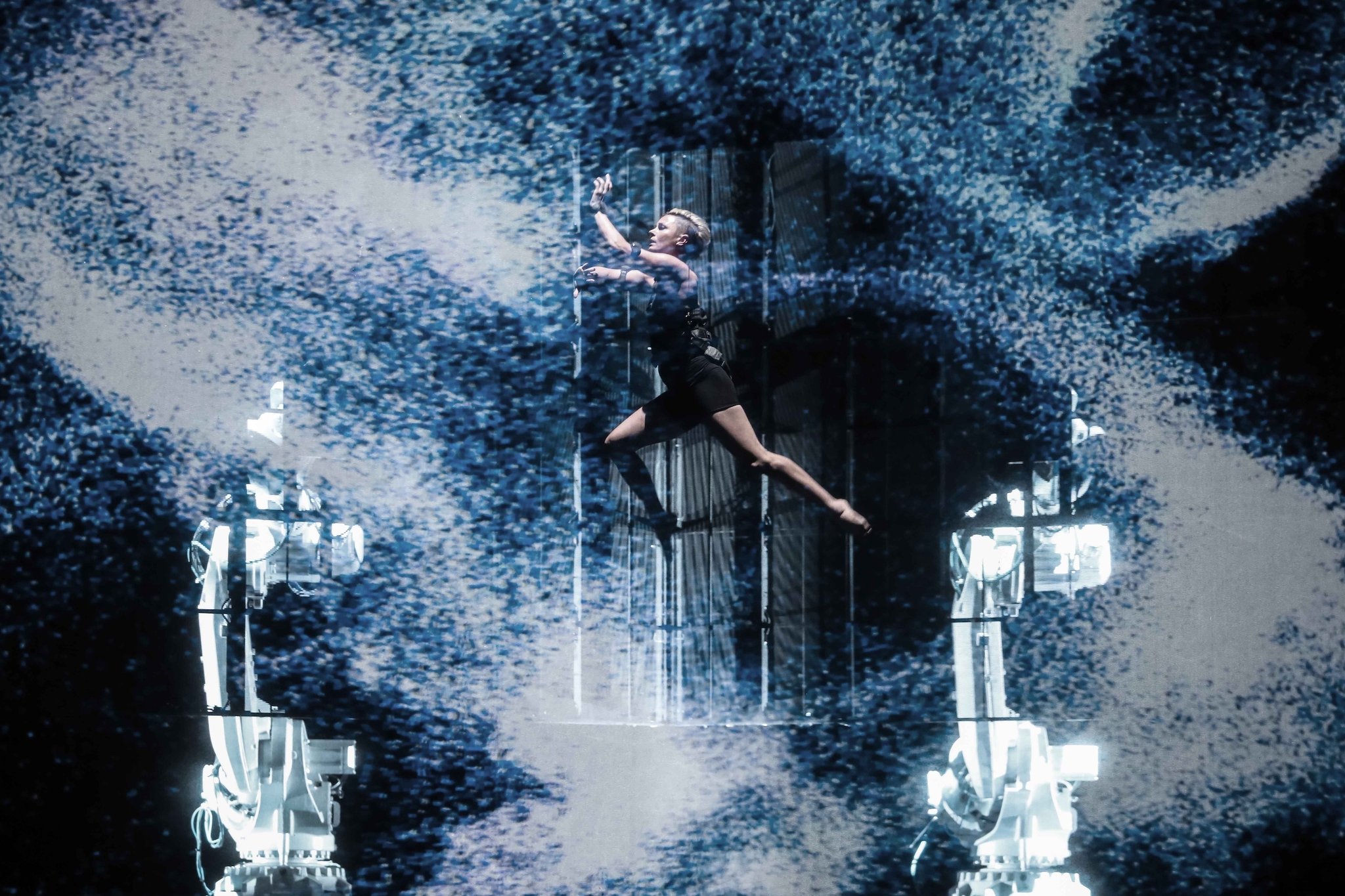
The idea of visualising a dynamic three-dimensional space led to the development of a unique setup. The result is a configuration featuring a double front projection onto a holographic screen and two LED screens mounted on robotic arms. The movements of the robots alter spatial perception on stage, becoming an integral part of the choreography.
To enhance the immersive effect, the two LED screens were used as windows into a three-dimensional space behind them, revealing different areas of the real-time generated landscape depending on the robots' movements.
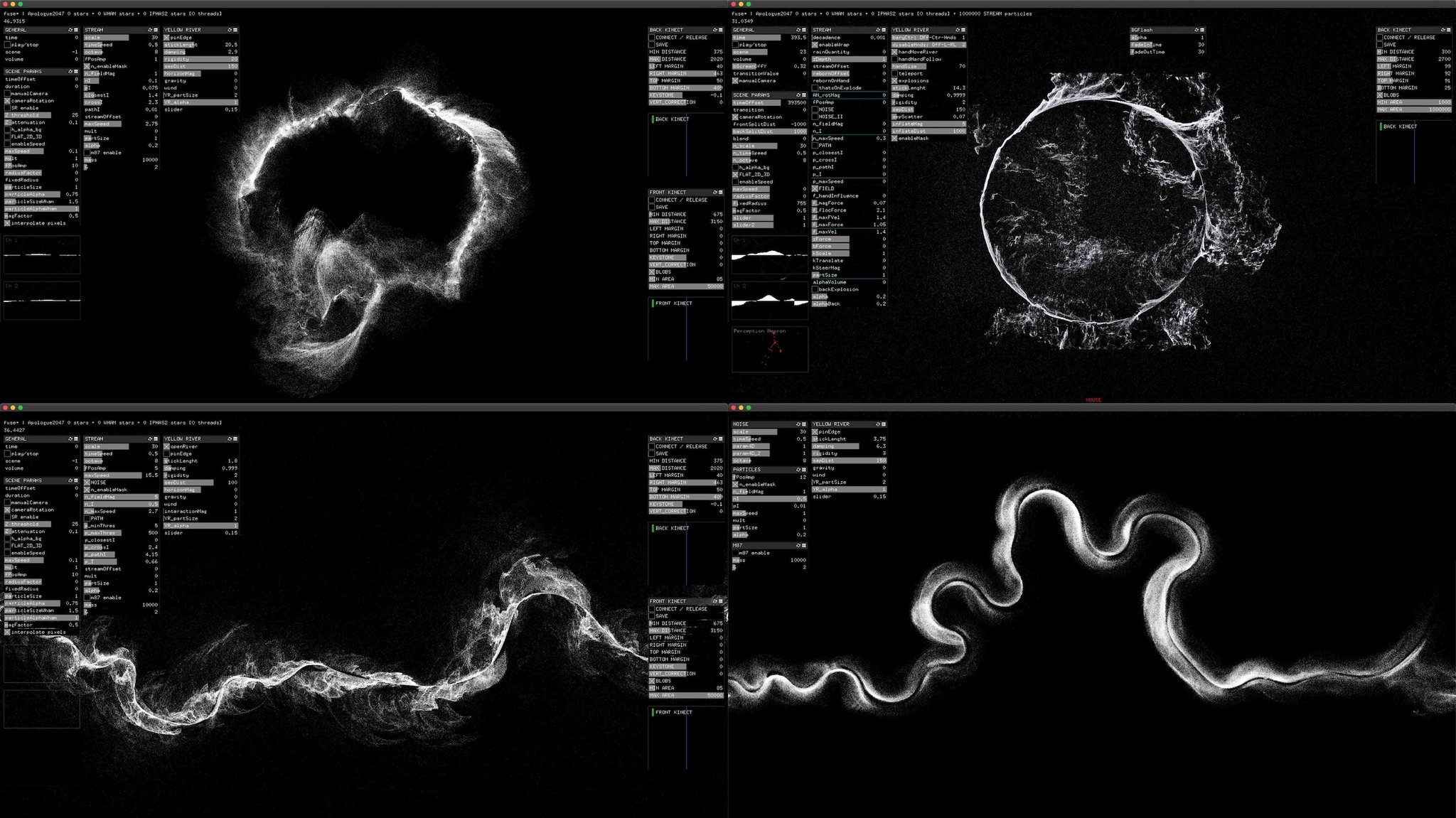
The digital landscapes were generated using software capable of reading and processing data in real-time. The data was collected through a depth camera and a motion tracking system worn by the performer.
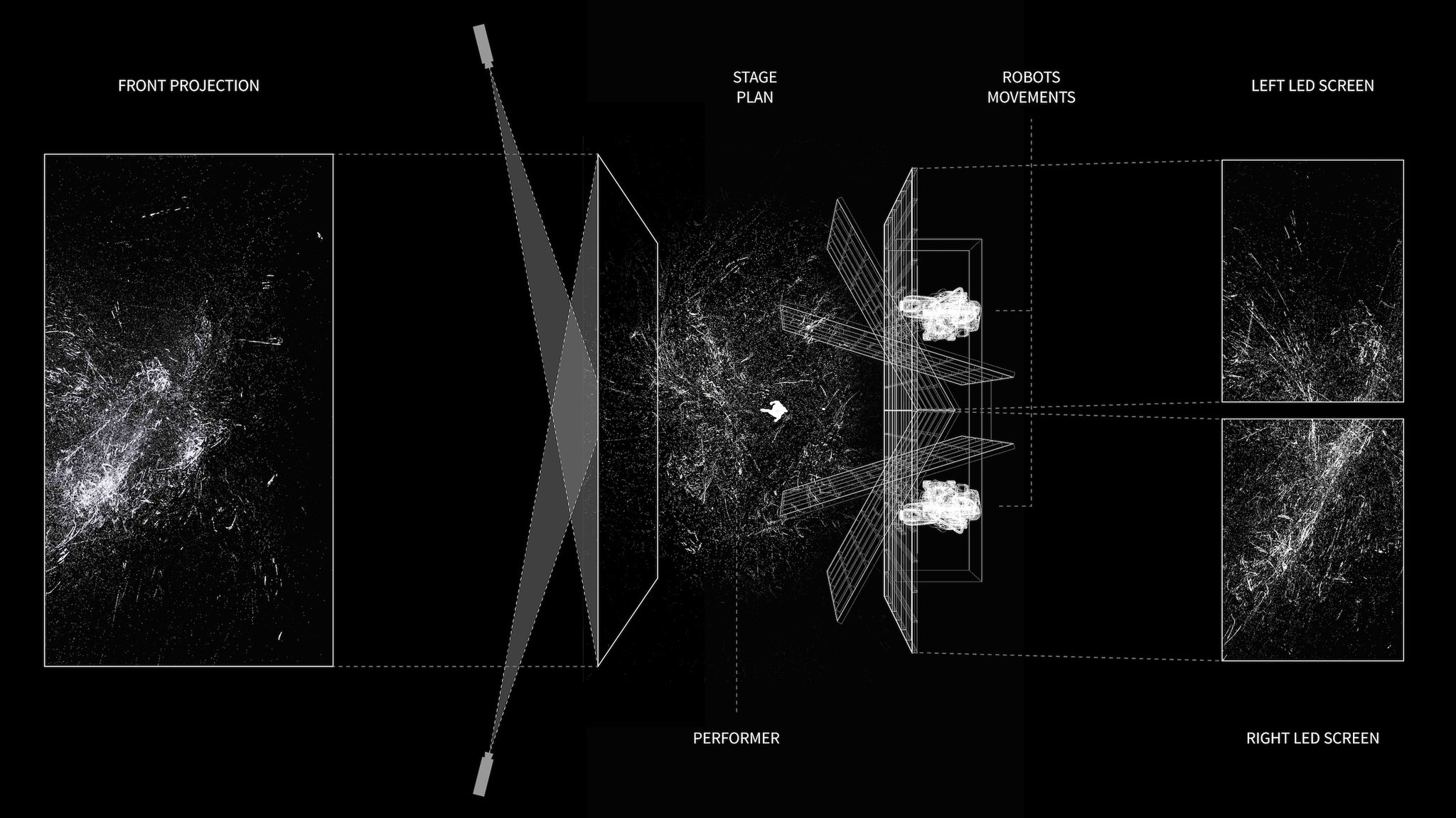
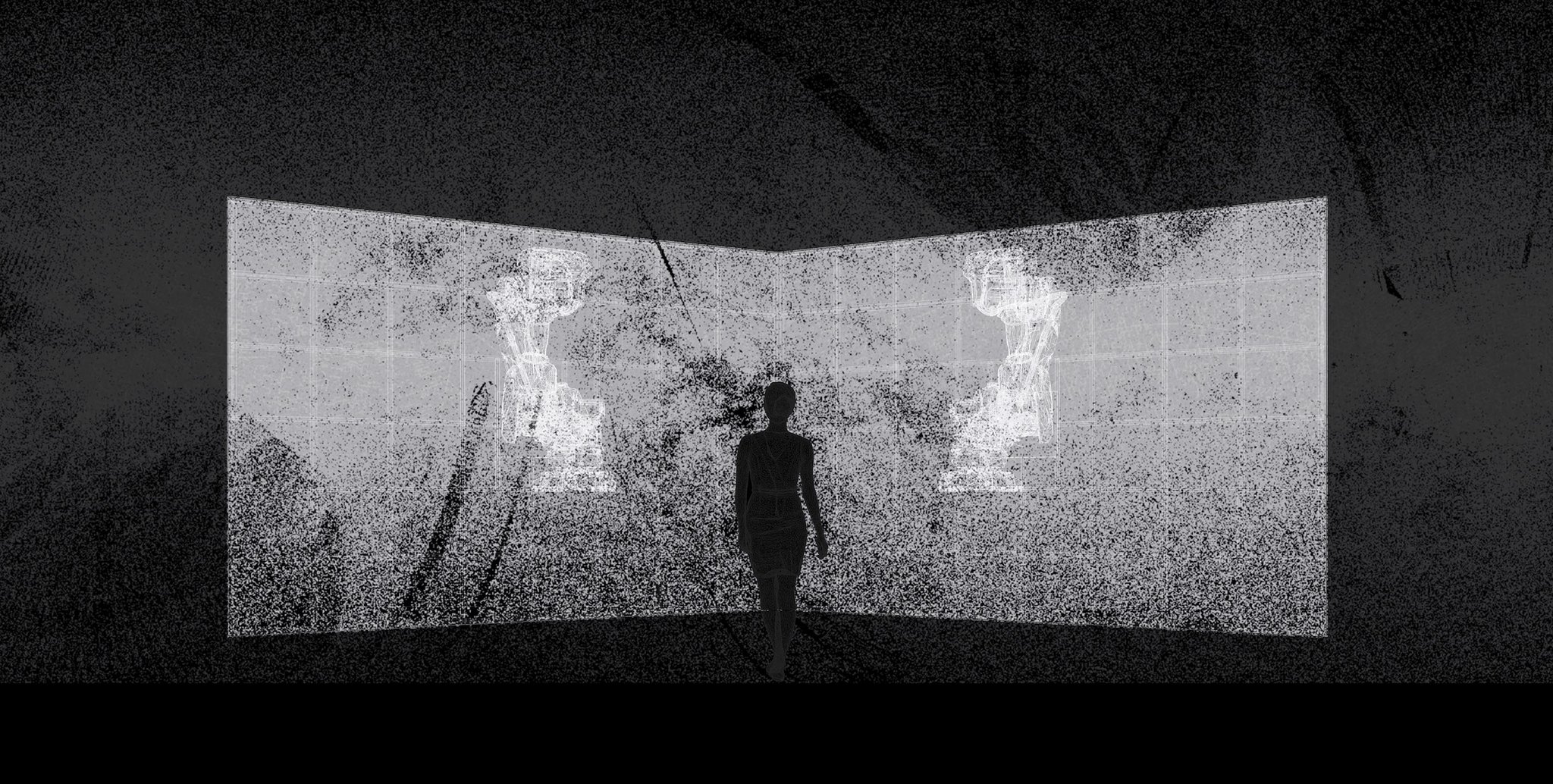
The generation of digital landscapes is created through software capable of reading and processing data in real-time. The data is obtained through a depth camera and a motion tracking system worn by the performer.
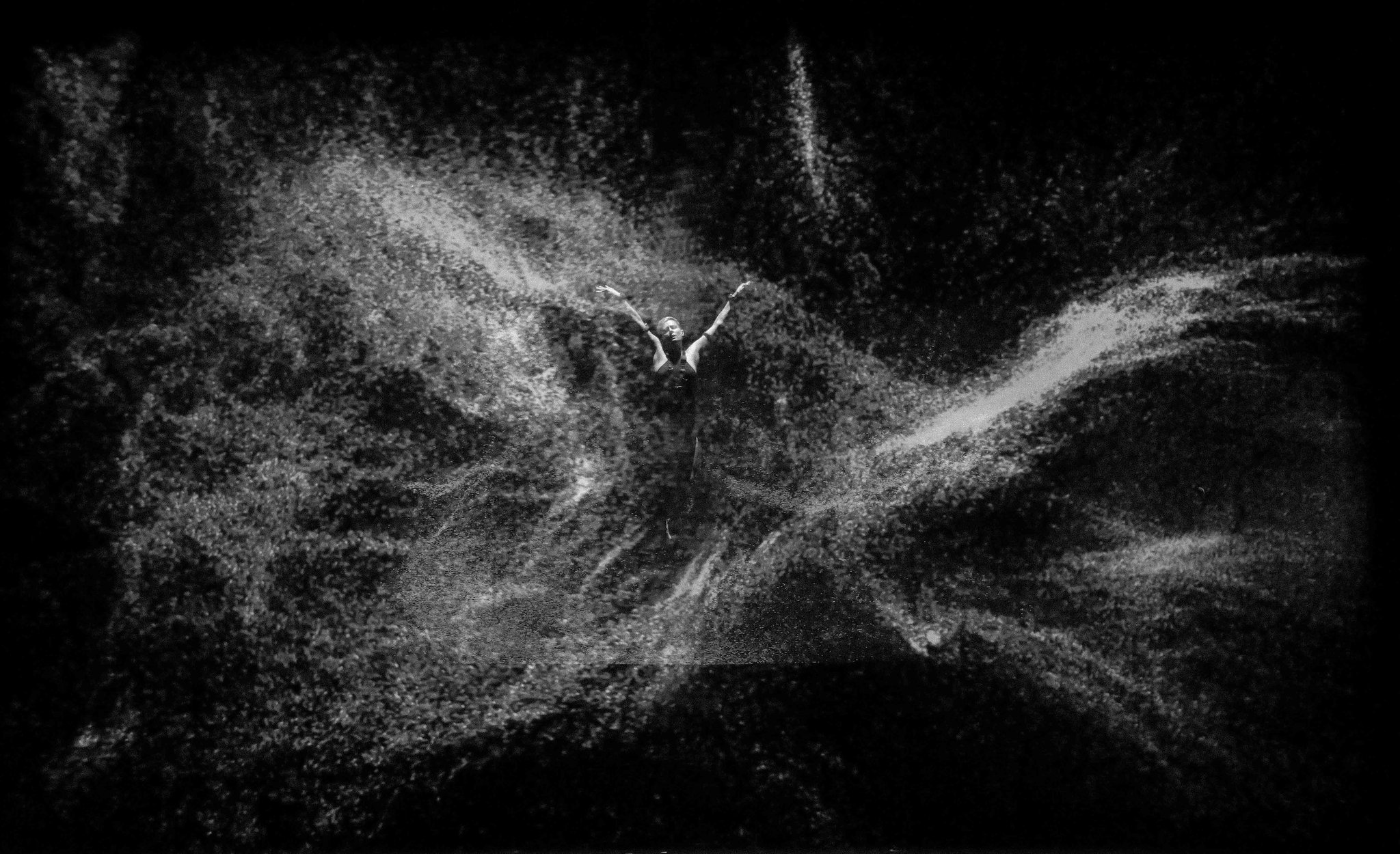
The choreography was developed through continuous integration between body movement and its influence on the digital landscape. During the performance's development, the aim was to achieve a level of interaction that felt as natural as possible, ensuring expressive freedom and room for improvisation for the dancer. The entire piece unfolds in "rooms" where the digital landscape changes in response to gestures, movements, and positions. The overall dynamic of the performance sees a continuous increase in the system's entropy, represented both through body language and by altering the behaviour of the visual component.
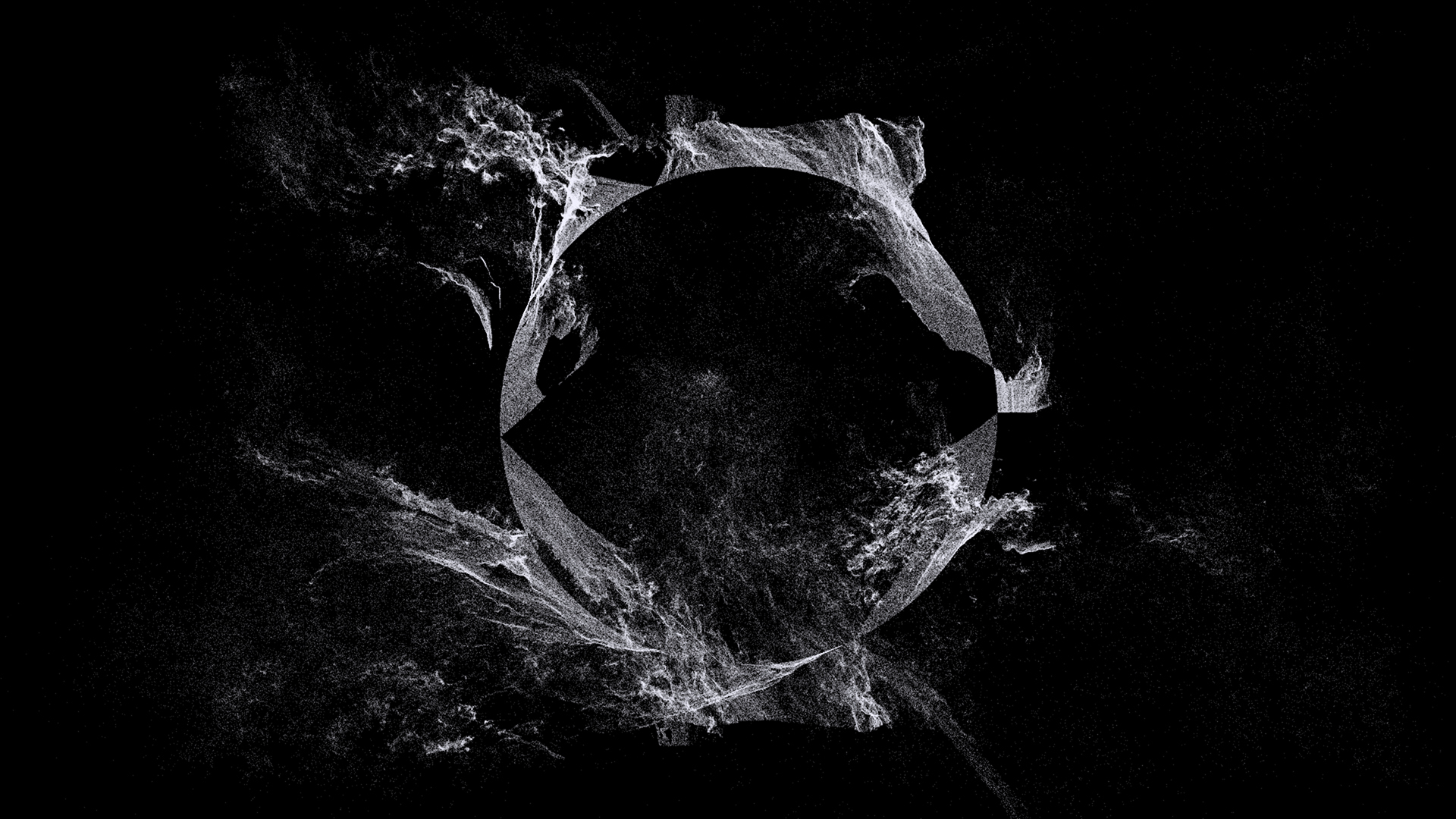
The digital landscapes through which the narrative unfolds were inspired by studies on the visualisation of the universe. The Gaia Archive was used as a data source for representing the exact positions of stars in the sky.
Through this data reading, the visualisation of the Milky Way's disk was created, including a thick layer (many thousands of light-years) of ionised gas, dubbed the Warm Ionized Medium (WIM). This layer appears to be fueled by ongoing star formation. The data comes from the Wisconsin Hα Mapper and its Hα Sky Survey.
Inspired by the idea of paralleling terrestrial flows with astral movements, a digital simulation was created to replicate the dynamics of rivers evolving over time. The study delved into and depicted, through various visual experiments, how rivers alter their courses and direction in response to external influences.